In many manufacturing companies, the flow of pallets is still handled on a daily basis by forklift operators or employees who “just handle it on the side.” That may seem logical and efficient, but in practice, it often costs more than meets the eye.
Every trip, wait, or extra step is a link in the process. If pallets aren’t available on time, a machine comes to a standstill or an employee has to stop working. This creates an internal logistics system that depends on availability, timing, and improvisation. And that’s exactly where the hidden costs lie.
Internal logistics may seem like a minor detail, but in reality, it largely determines the pace of production.
The invisible costs of internal transport
The costs of internal transport aren’t just about people and equipment. They’re actually in everything that happens in between:
- employees interrupting their work to move pallets
- downtime because internal transport isn’t immediately available
- inefficient routes and ad hoc movements
- safety risks and the potential for damage
- dependence on available staff (with forklift certification)
These costs are often not immediately visible in a budget, but they are incurred on a daily basis.
What changes with an AGV?
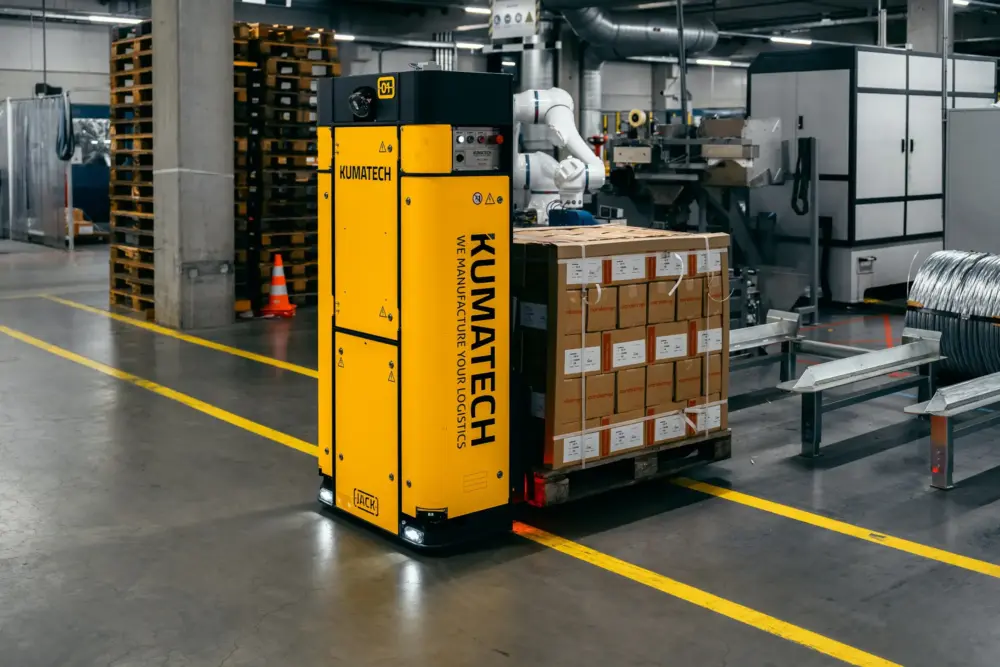
An AGV (Automated Guided Vehicle) automates these pallet movements and integrates them into a fixed and predictable process. Instead of having someone wait, search, or step in, a logistics flow is created that simply continues uninterrupted.
An AGV operates as needed, following a fixed route and without relying on available staff. This ensures process continuity, fewer interruptions, a more stable production flow, and less reliance on people for repetitive transport tasks. So it’s not about speed in the sense of ad-hoc adjustments, but rather consistency and reliability.
What are the financial benefits?
Internal transport often seems like “just part of the job.” But what does it really cost when you break it down? Let’s take a look at and compare a common scenario: a forklift operator who is (partly) responsible for internal pallet transport.
When calculating the annual cost of a forklift, we take several factors into account, such as the operator, forklift rental, maintenance, and any damage:
| Forklift costs per hour (average) incl. driver | € 50,- |
| Total per 8-hour working day | € 400,- |
| Total per year (1 shift) | € 92.000,- |
Now that we know a forklift with an operator costs approximately €92.000,- per year, the comparison is easy to make. A KUMATECH AGV (Pallet Jack) costs approximately €85.000,- including implementation.
An AGV does not replace all forklift work. In practice, we see about 80% of internal transport can be effectively automated. That amounts to about 6,4 hours per day, meaning the investment is often recouped within one to two years.
Even when an AGV handles only part of the transport, the benefits are already noticeable. Not only in terms of costs, but also in terms of continuity: an AGV operates continuously, is always available, and ensures a stable logistics flow. The savings, therefore, come from eliminating daily inefficiencies. In practice, we see that AGV projects often have a payback period of 1 to 2 years. Not just because of a single major cost saving, but because of the structural improvement of the process.
Less dependent on staff
At a time when labor is in short supply, internal logistics is increasingly becoming a bottleneck.
By automating pallet flows:
- dependence on forklift drivers decreases
- space is freed up for value-added work
- the process continues to run, even with fluctuating staffing levels
An AGV does not replace people, but ensures that people can focus on their own work instead of internal transport.
Start small, think big
An AGV solution doesn’t have to be a large-scale, sweeping undertaking. In fact, by starting small—for example, with a single component within the process—you can quickly gain insight and build confidence.
That’s why at KUMATECH, we work with modular solutions that are easy to implement into existing processes. This way, automation grows alongside the process, without unnecessary risks or complexity.
Pallet Dispenser and AGV
Automating pallet handling doesn’t even have to start with an AGV right away. A Pallet Dispenser, for example, can be an excellent first step and provide:
- pallets that are always available
- less manual stacking
- less physical strain
- greater visibility and safety
It’s not about the technology, but about improving the process.
“So the question is not just: What does an AGV cost?
But above all: what does it cost to leave it as it is?”
Curious what automating your pallet flow can mean?
Please feel free to contact us, we are happy to think along with you from the perspective of your practice.