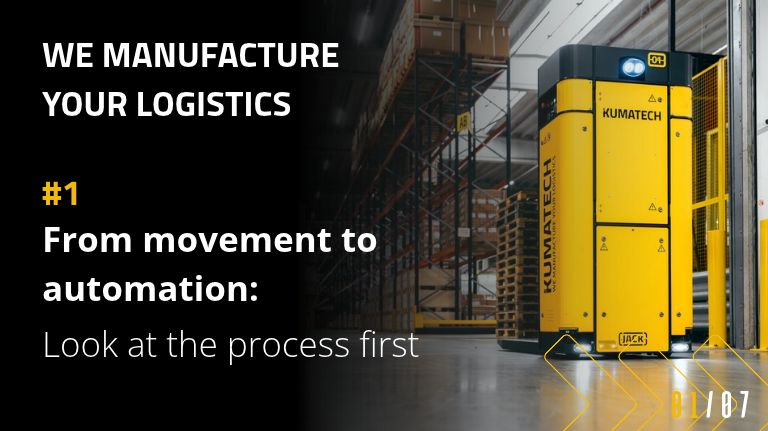
For us, an automation project doesn’t begin with choosing a vehicle. We start by looking at the process. That’s where our series From Movement to Automation begins.
Four questions about the process
Before we talk about solutions, we map the movements on the working floor together:
- What needs to be moved?
- Which routes are driven again and again, every single day?
- Where do employees lose time on transport?
- Where does downtime occur because materials aren’t available on time?
So the question isn’t “Which AGV do we need?” but “Which movement do we want to organise more smartly?”
The same movement, just smarter
Take a simple movement: a pallet from A to B. Done manually, it means physical strain, lost time and a risk of damage, and it doesn’t scale when demand grows. With an AGV, the movement stays exactly the same, only without the manual labour. The AGV can operate around the clock, drives safely and precisely, and is easy to scale up.
Lifting pallets? Not anymore
Stacking empty pallets is another movement that is often overlooked. Lifting and stacking pallets by hand can cause back strain, overexertion and the risk of trapped fingers or cut by splinters. A Pallet Dispenser ensures a constant supply and removal of empty pallets without physical strain. This ensures pallets are always available and supports a continuous process.
Only then, the solution
Only once the movements are clear do we look at which form of automation fits. Sometimes that’s a single AGV taking over a repetitive route. Sometimes the process calls for multiple vehicles, automated pallet handling, smart transfer points or integration with machines and storage systems. The goal stays the same: less manual work, more flow.
Download the infographic The Same Movement. Just Smarter. as a PDF. Handy to keep or share internally.
Curious which movements in your process could be smarter? Feel free to get in touch and we’ll map them out together.
Continue reading in part 2: What needs to be transported