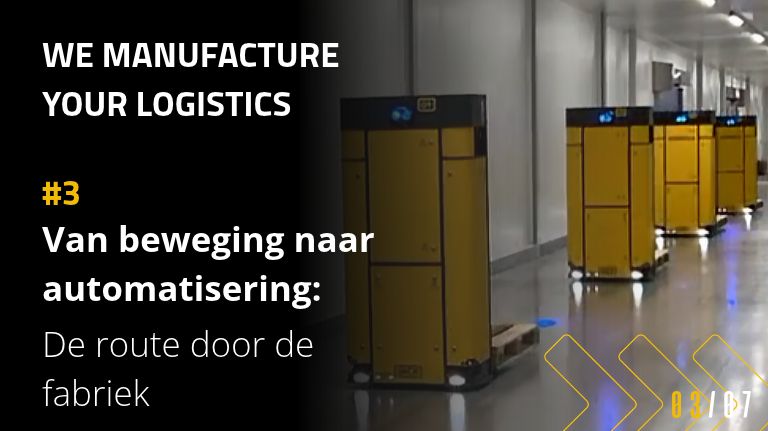
When automating internal transportation, it’s not just about what needs to be transported, but also about the route the materials take. In a production environment, people, machines, and materials are constantly on the move. How do you ensure that an AGV can navigate through this environment reliably and predictably?
A fixed route in a dynamic production environment
In the first two parts of our series “From Movement to Automation,” we looked at the production process and the materials that need to be transported. The next step is the route through the factory.
After all, an AGV doesn’t operate in an empty factory. Along the way, there are employees, forklifts, intersections, doors, and sometimes even elevators or narrow passageways. The floor on which the AGV travels also plays an important role.
That is why, when automating internal transportation, we look beyond just the distance between A and B. The entire route and the conditions under which the AGV must operate on a daily basis determine which solution is the best fit.
Fixed routes without physical guidance
Our AGVs are designed for everyday use in manufacturing and industrial environments. They follow fixed routes without requiring induction loops or other physical guidance systems embedded in the floor. That doesn’t mean the route must always be completely clear. The AGV detects obstacles, such as employees or other vehicles, and stops when the path is blocked. As soon as the route is clear again, it continues on its way.
This ensures that transportation remains predictable, even on a production floor where various tasks and transportation movements take place simultaneously.
Not every production floor is the same
In addition to the route itself, the floor surface is also important. Industrial floors are not always perfectly smooth and can have a variety of textures and finishes.
Our AGVs are suitable for various industrial floor surfaces. We also take into account changes caused by daily use, wear and tear, and construction work.
Thanks to Continuous Mapping, the navigation map is constantly updated while the AGV is in motion. This allows the AGV to maintain its orientation and follow its set route, even when the floor changes due to wear and tear or construction work.
A fixed route does not, therefore, mean that the floor must always remain exactly the same.
Adapt the AGV to real-world conditions, not the other way around
In a production environment, conditions are constantly changing. People are moving around, materials are being brought in and taken out, and floors are put through a lot every day.
That is precisely why it is important an AGV is not only suitable for the planned route, but also for the conditions in which it must operate on a daily basis.
Don’t adapt the factory to the AGV; instead, adapt the AGV to the realities of the factory floor.
Read more: From Manual Handling to Automation
In this series, we’ll highlight the key considerations involved in automating internal material handling operations.
Part #1 – Start by examining the process
Which transport movements occur on a daily basis, and where are the opportunities for automation?
Part #2 – What needs to be transported?
Why the cargo, dimensions, and method of handling are key factors in determining the transport solution.
In the following sections, we will take a closer look at the choice of technology, an efficient material flow, and the integration of different systems.